This article on the ongoing decline in Canadian voter participation, particularly by youth in the Globe today by Michael Adams, President of the Environics Institute for Survey Research and Maryantonett Flumian, President of the Institute on Governance has been shared by more than a few people I know on Facebook, so I thought I would share my thought on the subject and some of the ideas the article raises.
"One reason for declining turnout is a deep shift in social values away from deference to institutional authority. It used to be that if society’s leaders told us to do something, we did as we were told. Now people are more likely to make personal calculations about whether voting is worth the effort. Canadians are also less driven by a sense of duty than they once were. Eighty-three per cent of Canadians over 60 say voting is a duty; 48 per cent of those 18 to 39 agree."
The decline in voter turnout over the past several decades is an inarguable fact, in large part driven by the continuing low turnout of Canadians under the age of 40. An interesting idea, however, is that while Canadians have turned away from voting as duty that must be done in service, Canadians do seem to still be engaged in voluntary civic activity that could be described as informal activism, compared to the "hard" activism of casting a ballot:
"Indeed, recent research conducted by the Environics Institute as part of the biennial Americas Barometer survey, supported by the Ottawa-headquartered Institute on Governance, found Canadians expressing civic engagement in a number of ways besides voting. These included signing petitions, sharing political information online, and participating in demonstrations and protests."
A couple of thoughts: One, I think the relationship between these two sets of data (declining voter turnout but a continuing level of engagement in politics and public affairs being expressed through other, more informal activity) is a point against mandatory voting, a potential idea the authors float in the piece. Introducing mandatory voting would be a way to bootstrap voter turn out for sure, but given that Canadians are turning away from voluntary voting when cast as a duty, I have serious doubts it would improve the actual character of Canadian politics. (I'm also going to take this opportunity to shameless promote improving civic education, an issue I have heavily advocated for and engaged with as readers of this space would know).
The other thought that I have related to casual vs formal political engagement, particularly as it relates to youth. When you sign a petition, go to a rally, share something on Facebook, re-tweet something, or yes, write a blog, you get an immediate result, some emotional fulfillment that you have done something. People might like the post, re-tweet it to others, post a photo of going to a rally, etc. It gives you an immediate return on the emotional investment you put into it. It feels good to do these things, and they are relatively simple and time effective ways to help promote a cause you feel inclined towards.
If you are effective enough, or the enough people are a part of the same cause, you can even get some pretty tangible results from casual activism, particularly since online activism happens in real time and can snowball pretty quickly. We've seen this happen enough times that I don't have to link a particular example even; a person, brand, company etc sends out an insensitive tweet, says something discriminatory, etc. It gets publicized, hundreds of thousands of people tweet, Facebook, blog or something else the dismay and condemnation towards this, and the offending party issues an apologize, removes a social media manager, or announces a change in policy. I'm honestly not demeaning those who engage in a lot of political activity and activism online, since it can in fact have a pretty quick result. You see something you don't like, you share a message publicizing the offending content or spreading a message, which lets you feel like even as an individual you are part of a greater cause, and not infrequently, you actually get a tangible reaction.
Compare that to the relatively more glacial pace of "hard" activism in politics and government. Bills go through multiple readings, go to committee, and can take years to be fully implemented, and that's just on the government side. Within political parties, ideas can take years to gain popular support and become politically acceptable enough to become official party policy.
Right now, I have plenty of things that I'm annoyed at about the Harper government. Using the traditional tools of formal political engagement, what are my options. Well, I'm helping out my local Liberal candidate, encouraging people to read up on him, and consider voting for him...in an election that is scheduled to happen 8 months from now. And even if I do manage to change to minds of a lot of people at the doors, we have a majority government federally right now, so if the Conservatives just want to try and ride out the storm and push whatever issue and policy forward, they're fully capable and entitled to under out parliamentary system.
Sure, occasionally we've seen public opposition ferment to the degree that the Conservatives have had to back track or change course on a handful of initiatives such as the Fair Elections Act and potentially Veterans Affairs, but by and large in a majority government, the ruling party can do whatever they please as long as they keep at least a certain segment of the electorate onside, regardless of how loud those who are in opposition howl, or tweet, or blog, protest or petition. (I'm using the Conservatives as a punching bag, but I'm take my partisan hat off as the core concept remains the same regardless of which party holds power.)
So with that in mind, what can political parties and "traditional" political activists like myself do?
I think blending the ideas of formal and informal activism, through use of national days of action to train volunteers outside of an election period, but also things like internal petitions and social media teams are important. These are both ideas that have been developed in large part from the Obama campaign and brought north. While constant emails from parties can get annoying sometimes, you wouldn't get them so constantly if they weren't effective at engaging you in between elections.
I also think this should be a lesson to parties and activists to push to make sure they are responsive and relevant to the issues that people care about, as opposed to scandal mongering whatever happens to be the issue of the day. This is something that, to be frank, in the run up to the last federal election I think the opposition did too much, and it allowed Harper is position himself as "the only leader focused on jobs and the economy", with a similar scenario I think playing out in Ontario with Hudak's relentless focus on smearing the government when people had in large part moved on and wanted to hear what parties said on other issues.
Ensuring parties themselves are open is also important to make sure people's itch of engagement is scratched. The introduction of the supporter category during the federal Liberal leadership was a good first step, but personally I wouldn't be opposed to going a step further and letting supporters vote in nomination meetings.
If we are, as Susan Delacourt suggests in Shopping for Votes, that Canadians are taking a more consumer based approach to politics, Canadian political parties can't afford to overlook the importance of instant gratification in appealing to both the population as a whole and potential volunteers and activists.
Showing posts with label education. Show all posts
Showing posts with label education. Show all posts
Monday, January 26, 2015

Monday, July 14, 2014
CBC article on Ontario budget mentions my youth voter registration policy

Yes, this is shameless self-promotion on my part, but hey, my Mom thought it was cool:
"The Liberals also plan to revamp the Grade 10 Civics curriculum to get students more involved in their communities and introduce voter registration in high schools."
Sunday, May 25, 2014
My policy on improving civic education makes the Ontario Liberal Party platform!

Readers of this space will remember my policy on youth voter registration that was passed as a priority policy at the Ontario Young Liberals Summer Fling last year. The policy was also debated on Common Ground platform building discussion site where it became one of the top ranked policies in the education section.
Today, I am very proud to say my policy has been adopted as a part of the Ontario Liberal Party platform!
"ENGAGING OUR YOUTH.
We will introduce voter registration in high schools to help students prepare for the responsibilities of citizenship and replace the Grade 10 Civics curriculum with a more hands-on course that includes a community improvement project."
Thanks to everyone who supported my policy at every step of way!
Saturday, November 30, 2013
Common Ground voting is closing soon, support my policy on Encouraging Youth Voter Participation and Improving Civic Education!
http://commonground.ideascale.com/a/dtd/Encouraging-Youth-Voter-Participation-Improving-Civic-Education/13731-25935
It's on a Liberal website, but I think it's a good non partisan idea that could have a positive impact on youth participation in the electoral process.
Many American states allow for youth voter pre-registration, so this isn't a radical idea - it works in other places, why not Ontario? The Chief Electoral Office of BC recommended British Columbia take a look at youth pre-registration, why not Ontario?
It takes just a couple minutes to register and vote, and I encourage you to read more about the policy here.
It's on a Liberal website, but I think it's a good non partisan idea that could have a positive impact on youth participation in the electoral process.
Many American states allow for youth voter pre-registration, so this isn't a radical idea - it works in other places, why not Ontario? The Chief Electoral Office of BC recommended British Columbia take a look at youth pre-registration, why not Ontario?
It takes just a couple minutes to register and vote, and I encourage you to read more about the policy here.
Saturday, October 12, 2013

Thursday, September 26, 2013
Brush up on my youth democratic participation and civic education policy in time for provincial council!
With provincial council coming up this weekend, here's a brush up on my policy that got prioritized by the Ontario Young Liberals at Summer Fling back in August. Here is a blog post I wrote outlining some of the stats and evidence behind this policy, and why I think it would work for Ontario.
ENCOURAGING YOUTH DEMOCRATIC PARTICIPATION AND IMPROVING CIVIC EDUCATION
BY:
WILLIAM NORMAN, MISSISSAUGA SOUTH
WHEREAS the lowest voter registration
rates are for young voters 18-24 years of age
WHEREAS there is a positive correlation
between voting and being registered as a voter before General Voting Day
WHEREAS Australia and several American
states allow for voter registration below the age of 18
WHEREAS the Chief Electoral Officer of
British Columbia recommended in 2011 in his Report to the Legislative Assembly
to amend the BC Elections Act to allow the provisional registration of
individuals when they are 16 years of age
WHEREAS Ontario Young Liberals have
previously passed policies encouraging youth democratic participation and
improving the Civics class as part of Ontario’s curriculum
BE IT RESOLVED THAT the Ontario
government amend the Ontario Elections Act to permit the registration of
individuals onto the voter list when they are 15 years of age
BE IT FURTHER RESOLVED THAT the Ontario
government amend the Ontario High School curriculum to include the voter
registration process, as the majority of students in grade 10 would be 15
BE IT FURTHER RESOLVED that the Ontario
government continues to work with post-secondary educational institutions to
help students living away from home vote.
Tuesday, August 13, 2013
Final version of my policy to be presented at Summer Fling: Encouraging Youth Democratic Participation and Improving Civic Education
My original policy had some friendly amendments for clarity and language, so here is what I'll be presenting at Summer Fling this weekend:
Encouraging Youth Democratic Participation and Improving Civic Education (Provincial)
By: William Norman, Mississauga South
WHEREAS – The lowest voter registration rates are for young voters 18-24 years of age
WHEREAS – There is a positive correlation between voting and being registered as a voter before General Voting Day
WHEREAS – Australia and several American states allow for voter registration below the age of 18
WHEREAS – The Chief Electoral Officer of British Columbia recommended in 2011 in his Report to the Legislative Assembly to amend the BC Elections Act to allow the provisional registration of individuals when they are 16 years of age
WHEREAS – Ontario Young Liberals have previously passed policies encouraging youth democratic participation and improving the Civics class as part of Ontario’s curriculum
BE IT RESOLVED THAT – The Ontario government amend the Ontario Elections Act to permit the registration of individuals onto the voter list when they are 16 years of age
BE IT FURTHER RESOLVED THAT – The Ontario government amend the Ontario High School curriculum to include the voter registration process, as the majority of students in grade 10 would be 16.
Here are some backgrounders promoting youth pre-registration:
"Encouraging youth participation
The lowest voter registration rates are for young voters 18-24 years of age. There is a
positive correlation between voting and being registered as a voter before General Voting
Day. The most effective means of registering youth may be to approach them before they
graduate from high school. Currently, voter registration is restricted to those at least 18
years of age, an age when many youth have left high school.
Australia has addressed this issue by allowing provisional voter registration of 17 year
olds. Several American states have provisional registration for 16 or 17 year olds, or
have introduced Bills or declared their intention to do so in this regard.
Legislators may wish to consider allowing the provisional registration of individuals
when they are 16 years of age. The voting age could remain at 18, with provisional
registration becoming an active registration on an individual’s 18th birthday. Permitting
early registration at the age of 16 would permit Elections BC to work with schools and
the driver licensing program to ensure maximum exposure to the registration process for
young voters. Many high school teachers have expressed support for this concept as it
would allow meaningful action by their students in the context of civics education.
Improving the accessibility of registration opportunities for youth may have a longer-term
effect on voter engagement and turnout."
"Several other states have changed registration rules to encourage civic participation by youth.
In Hawaii, eligible 16-year-olds are allowed to pre-register so that their voter status is
automatically activated at age 18. In the states of Connecticut, Iowa, Florida, Maine,
Wisconsin, Missouri, and Texas, pre-registration is open to 17 year olds. Federal legislation
was introduced in 2004, the Gateway to Democracy Act, to allow teenagers to preregister,
with an emphasis on those applying for their driver’s licenses (in most states, at 16 years of
age). Wisconsin reaches out to young voters with a state law establishing a “registration
deputy” at every high school, filled by a volunteering teacher or staff person."
"Thousands of young people in these states take advantage of preregistration, and preregistration appears to have positive and persisting long-term effects on their voting propensities...Success of preregistration is maximized when election officials and educators act as partners.... As policy makers consider how to implement preregistration programs elsewhere, providing for means of ensuring participation by educators, such as requiring preregistration as a component of a mandatory high school civics curriculum, will likely result in the most robust implementation of preregistration."
That last quote I think really brings it home.
Tuesday, February 26, 2013
Tim Hudak says Ontario is protecting too many endangered species?

Bit of an odd priority for a leader looking to be taken more seriously, but here we are. Hudak's already on the record as wanting to eliminate full day kindergarten and put 10,000 education workers out of a job, but I guess we can add endangered species to Hudak's chopping block.
Tuesday, February 12, 2013
Hudak would end support for students from low income families with attack on 30% tuition rebate
Tim Hudak rolled out his latest double down on right-wing policy, announcing he would end the 30% tuition rebate for Ontario post-secondary students.
Hudak and his post-secondary education critic, Rob Leone framed the tuition cut as not helping mature students or single parents (ironic, given the not so high regard single mothers have been held in historically by conservatives).
They also seem to want to restrict the way students could use the use any financial assistance they would receive:
"The Tories say student aid should be given to students who are getting good marks and can show they're using the money to improve their education."
What does "improve their education" mean, exactly? I, like many other students, used my 30% off tuition rebate to help pay the rent on my apartment, would Hudak force students like me to spend it on textbooks I could check out of the library and worry about a place to live?
The idea of tying student aid to performance seems attractive on the surface, but is in fact highly problematic and regressive. Under Hudak, would a student from a low-income New Canadian family, perhaps the first in her family to attend a post-secondary institution with a B average receive less financial support than a student from a high-income family with who had an A average? If a student from a low income family in first year university was finding the transition to university difficult to deal with, and their marks were lower than expected be cut off from financial aid, thus dramatically increasing the risk of this student dropping out? If a student were struggling with depression or another mental health issues and it affected his or her grades, would Hudak slash aid for this student?
The 30% tuition cut was designed specifically for full time undergrad students from low income families to help ease the financial burden of post-secondary education. It helped me and students across Ontario like me to focus on education and preparing ourselves for the global economy. Any move away from a system in which income is the main qualifier for student aid is deeply regressive and shows how out of touch Tim Hudak is with working families, students, and youth across Ontario.
Hudak and his post-secondary education critic, Rob Leone framed the tuition cut as not helping mature students or single parents (ironic, given the not so high regard single mothers have been held in historically by conservatives).
They also seem to want to restrict the way students could use the use any financial assistance they would receive:
"The Tories say student aid should be given to students who are getting good marks and can show they're using the money to improve their education."
What does "improve their education" mean, exactly? I, like many other students, used my 30% off tuition rebate to help pay the rent on my apartment, would Hudak force students like me to spend it on textbooks I could check out of the library and worry about a place to live?
The idea of tying student aid to performance seems attractive on the surface, but is in fact highly problematic and regressive. Under Hudak, would a student from a low-income New Canadian family, perhaps the first in her family to attend a post-secondary institution with a B average receive less financial support than a student from a high-income family with who had an A average? If a student from a low income family in first year university was finding the transition to university difficult to deal with, and their marks were lower than expected be cut off from financial aid, thus dramatically increasing the risk of this student dropping out? If a student were struggling with depression or another mental health issues and it affected his or her grades, would Hudak slash aid for this student?
The 30% tuition cut was designed specifically for full time undergrad students from low income families to help ease the financial burden of post-secondary education. It helped me and students across Ontario like me to focus on education and preparing ourselves for the global economy. Any move away from a system in which income is the main qualifier for student aid is deeply regressive and shows how out of touch Tim Hudak is with working families, students, and youth across Ontario.
Friday, December 14, 2012
"Sousa sounded and looked very much like a man who would be comfortable as the next premier of the province."
Like the Sousa campaign on Facebook!
Follow Charles on Twitter!
This article is a couple days old now, but I wanted to post it to show the extremely positive reception Charles received talking to local business leaders in Mississauga, while also outlining his vision to create jobs and grow the economy to protect our gains in health care and education.
Ontario's leaders must govern by addressing the long-term needs of the province, not by "just looking at the next election cycle," Mississauga South Liberal MPP Charles Sousa told the Mississauga Board of Trade this morning...
The second-term MPP pressed his home field advantage in front of an attentive audience at the Mississauga International Centre by outlining his policies to improve life in the GTA, which he said was burdened by both traffic gridlock and "political gridlock."
It's finally time to build the high-speed rail connection from Windsor to Quebec City that every provincial government has talked about — but none has acted on — the Mississauga native said.
"It's time for action and we need to start with the Hamilton to Toronto and Toronto to Oshawa sections," he said.
Ontario must make significant long-term capital investments in high speed rail now because otherwise the economic benefit will be lost to the U.S., which is also looking at the prospect...
The former Labour and Immigration minister said the new policy he launched several weeks ago to attract more immigrants to Ontario is critical to meeting the province's future labour needs. "In the future 100 per cent of the net jobs will be filled by newcomers to Ontario."
Another long-term problem that has never been addressed, despite ongoing promises from every party, is the Ontario Condominium Act. Sousa promised "immediate reform” of the legislation to give owners a greater voice on condo boards and to force the licensing of condo managers.
Investing in post-secondary education in times of a down economy, such as the one we are in now, will pay huge dividends down the road as the economy recovers, argued the 54-year-old graduate of Gordon Graydon Secondary School.
He urged approval of a new university campus in neighbouring Milton, Ontario's fastest-growing municipality, as soon as possible.
"We have the funding. We need to act,” he said.
At ease in front of the friendly MBOT audience, Sousa sounded and looked very much like a man who would be comfortable as the next premier of the province.
"We do have a strong foundation in this province but we need to work together," he concluded. "It's not about the future of anyone's political stripe, it's about the future of the province."
Follow Charles on Twitter!
This article is a couple days old now, but I wanted to post it to show the extremely positive reception Charles received talking to local business leaders in Mississauga, while also outlining his vision to create jobs and grow the economy to protect our gains in health care and education.
The second-term MPP pressed his home field advantage in front of an attentive audience at the Mississauga International Centre by outlining his policies to improve life in the GTA, which he said was burdened by both traffic gridlock and "political gridlock."
"It's all about growing the economy and jobs," the MPP said. "That will allow us to pay for the things that really matter — health care and education."
Instead of headlines bemoaning the fact that traffic in the GTA is worse than it is in Los Angeles, Sousa said he wants to write a new economic story by implementing policies to create jobs and curb gridlock.
He outlined a five-point GTA plan that he claimed will put the 416 and 905 regions back on the road to prosperity.
"We can remove one complete layer of decision-making" by making Metrolinx responsible for MiWay, the TTC and all local transit systems in the GTA, he suggested.
Instead of headlines bemoaning the fact that traffic in the GTA is worse than it is in Los Angeles, Sousa said he wants to write a new economic story by implementing policies to create jobs and curb gridlock.
He outlined a five-point GTA plan that he claimed will put the 416 and 905 regions back on the road to prosperity.
"We can remove one complete layer of decision-making" by making Metrolinx responsible for MiWay, the TTC and all local transit systems in the GTA, he suggested.
It's finally time to build the high-speed rail connection from Windsor to Quebec City that every provincial government has talked about — but none has acted on — the Mississauga native said.
"It's time for action and we need to start with the Hamilton to Toronto and Toronto to Oshawa sections," he said.
Ontario must make significant long-term capital investments in high speed rail now because otherwise the economic benefit will be lost to the U.S., which is also looking at the prospect...
The former Labour and Immigration minister said the new policy he launched several weeks ago to attract more immigrants to Ontario is critical to meeting the province's future labour needs. "In the future 100 per cent of the net jobs will be filled by newcomers to Ontario."
Another long-term problem that has never been addressed, despite ongoing promises from every party, is the Ontario Condominium Act. Sousa promised "immediate reform” of the legislation to give owners a greater voice on condo boards and to force the licensing of condo managers.
Investing in post-secondary education in times of a down economy, such as the one we are in now, will pay huge dividends down the road as the economy recovers, argued the 54-year-old graduate of Gordon Graydon Secondary School.
He urged approval of a new university campus in neighbouring Milton, Ontario's fastest-growing municipality, as soon as possible.
"We have the funding. We need to act,” he said.
At ease in front of the friendly MBOT audience, Sousa sounded and looked very much like a man who would be comfortable as the next premier of the province.
"We do have a strong foundation in this province but we need to work together," he concluded. "It's not about the future of anyone's political stripe, it's about the future of the province."
Monday, August 27, 2012
"Students putting students first" - Ontario Student Trustees' Association calls Putting Students First Act "a fair deal", but will the NDP and Catherine Fife listen?
The NDP and Catherine Fife have already come out against the Putting Students First Act, but will they listen to the students of Ontario themselves or their big union money interests?
Here's what the Ontario Student Trustees' Association says about the Liberal government moving to make sure students are in class from day one of the school year in Kitchener-Waterloo and across Ontario
Hirad Zafari, OSTA-AECO President and Toronto DSB Student Trustee, called upon "provincial leaders and teachers' unions, specifically those who have not agreed to the OECTA framework, to ensure full-service education for all students this coming year."
Provincial leaders are calling on teachers' unions to take a two-year wage freeze as part of province-wide austerity in the face of a large deficit and growing Ontario public debt - "a fair deal, given the nine years of labour peace and the progress made in our schools" said Kevin Michael, Catholic Board Council President and Student Trustee at Dufferin-Peel Catholic DSB.
Tim Hudak showed he can't be trusted to protect stability in schools when he flip-floped and "condemned" full-day kindergarten, and Tracey Weiler showed she is no Elizabeth Witmer when it comes to standing up for Kitchener-Waterloo families by weakly saying she "supported [Hudak's] position". If Catherine Fife and the NDP put big union money (Fife hasn't issued any news releases about education, but she has about getting a public sector union endorsement) before what students want, what does that say about Fife's and the NDP's real priorities on education?
Here's what the Ontario Student Trustees' Association says about the Liberal government moving to make sure students are in class from day one of the school year in Kitchener-Waterloo and across Ontario
Hirad Zafari, OSTA-AECO President and Toronto DSB Student Trustee, called upon "provincial leaders and teachers' unions, specifically those who have not agreed to the OECTA framework, to ensure full-service education for all students this coming year."
Provincial leaders are calling on teachers' unions to take a two-year wage freeze as part of province-wide austerity in the face of a large deficit and growing Ontario public debt - "a fair deal, given the nine years of labour peace and the progress made in our schools" said Kevin Michael, Catholic Board Council President and Student Trustee at Dufferin-Peel Catholic DSB.
Tim Hudak showed he can't be trusted to protect stability in schools when he flip-floped and "condemned" full-day kindergarten, and Tracey Weiler showed she is no Elizabeth Witmer when it comes to standing up for Kitchener-Waterloo families by weakly saying she "supported [Hudak's] position". If Catherine Fife and the NDP put big union money (Fife hasn't issued any news releases about education, but she has about getting a public sector union endorsement) before what students want, what does that say about Fife's and the NDP's real priorities on education?
Saturday, August 25, 2012
Why is Eric Davis running in Kitchener-Waterloo?
Here's a great piece by Kitchener-Waterloo Liberal candidate Eric Davis answering the most basic question that anyone running for public office has to answer: Why are you running?
Eric's two big reasons are simple but moving: Public service and family.
Eric has a long track-record of local leadership in Kitchener-Waterloo, and he'll be a fighter to build a better future for Kitchener-Waterloo families.
I was raised to believe that each of us has a responsibility to contribute to the vibrancy and success of our community. Everyone contributes in their own way. Until now, my way has been through volunteering with a number of local organizations, most notably as the vice chair of the local United Way, and recently as chair of the local branch of the Canadian Mental Health Association.
However, I have also long believed that public service is an important responsibility and an honour. I look to former representatives such as Herb Epp, Andrew Telegdi and Elizabeth Witmer, and I see how our community has benefited from leaders who have been strong local representatives of Kitchener-Waterloo first and foremost.
Witmer served our community for 22 years as MPP. Despite our many philosophical differences, I have a great respect for her dedication to Kitchener-Waterloo. She served with honour and distinction, and I hope to follow her path of strong local representation through hard work and a commitment to our community.
Eric's other big reason for running hits close to home for me: To protect the public services that helped his family, and to build a better future for all families like his in Kitchener-Waterloo.
In particular, Eric drawing inspiration from his wife surviving breast cancer thanks in large part to investments in health care and breast cancer detection made by the McGuinty Liberal government (just as my mother is a breast cancer survivor) shows he has a personal stake in protecting the gains Ontario has made in health care.
At the age of 24, my wife Cynthia was diagnosed with breast cancer. For 18 months she underwent chemotherapy, radiation treatments, surgeries and countless doctor visits.
Today, we are thankful to say that she is a cancer survivor due, in large part, to Ontario’s health care system.
Though we will have to find efficiencies in our health care system to ensure its long-term sustainability, we must always ensure that it remains free, public and universal so that everyone experiencing a health challenge like my wife can avoid the worry of affordability and concentrate on recovery.
Our daughter Isabella is now two years old. As I have watched her grow, learning to speak and developing a love of books, I’ve gained an appreciation for the importance of early learning.
That’s why I fully support the Liberal government’s investments in education, including the introduction of full-day kindergarten and the strong commitment to smaller class sizes.
While the Hudak Conservatives and Tracey Weiler flip-flop on important issues like full-day kindergarten, and the NDP presents no real plan to balance the budget and ensure stability in schools, Eric Davis will be a strong fighter for the future of Kitchener-Waterloo families, motivated by the very best of concerns: The dignity of public service and protecting the health care and public education systems that have helped teach and heal generations of Ontario families.
Eric's two big reasons are simple but moving: Public service and family.
Eric has a long track-record of local leadership in Kitchener-Waterloo, and he'll be a fighter to build a better future for Kitchener-Waterloo families.
I was raised to believe that each of us has a responsibility to contribute to the vibrancy and success of our community. Everyone contributes in their own way. Until now, my way has been through volunteering with a number of local organizations, most notably as the vice chair of the local United Way, and recently as chair of the local branch of the Canadian Mental Health Association.
However, I have also long believed that public service is an important responsibility and an honour. I look to former representatives such as Herb Epp, Andrew Telegdi and Elizabeth Witmer, and I see how our community has benefited from leaders who have been strong local representatives of Kitchener-Waterloo first and foremost.
Witmer served our community for 22 years as MPP. Despite our many philosophical differences, I have a great respect for her dedication to Kitchener-Waterloo. She served with honour and distinction, and I hope to follow her path of strong local representation through hard work and a commitment to our community.
Eric's other big reason for running hits close to home for me: To protect the public services that helped his family, and to build a better future for all families like his in Kitchener-Waterloo.
In particular, Eric drawing inspiration from his wife surviving breast cancer thanks in large part to investments in health care and breast cancer detection made by the McGuinty Liberal government (just as my mother is a breast cancer survivor) shows he has a personal stake in protecting the gains Ontario has made in health care.
At the age of 24, my wife Cynthia was diagnosed with breast cancer. For 18 months she underwent chemotherapy, radiation treatments, surgeries and countless doctor visits.
Today, we are thankful to say that she is a cancer survivor due, in large part, to Ontario’s health care system.
Though we will have to find efficiencies in our health care system to ensure its long-term sustainability, we must always ensure that it remains free, public and universal so that everyone experiencing a health challenge like my wife can avoid the worry of affordability and concentrate on recovery.
Our daughter Isabella is now two years old. As I have watched her grow, learning to speak and developing a love of books, I’ve gained an appreciation for the importance of early learning.
That’s why I fully support the Liberal government’s investments in education, including the introduction of full-day kindergarten and the strong commitment to smaller class sizes.
While the Hudak Conservatives and Tracey Weiler flip-flop on important issues like full-day kindergarten, and the NDP presents no real plan to balance the budget and ensure stability in schools, Eric Davis will be a strong fighter for the future of Kitchener-Waterloo families, motivated by the very best of concerns: The dignity of public service and protecting the health care and public education systems that have helped teach and heal generations of Ontario families.
Wednesday, August 22, 2012
With education on the line, will Tim Hudak flip-flop on a wage freeze like he did on full day kindergarten?
We know Tim Hudak's position on full day kindergarten for Ontario families has gone from this:
 To this
"Tim Hudak...condemned the program, which is to be fully rolled out by 2014"
with Hudak's double flip-flop backed by Kitchener-Waterloo Progressive Conservative candidate Tracey Weiler:
"Weiler said that she “supports the leader’s position” on halting the rollout of full-day kindergarten in the province."
With the Ontario Liberals introducing the Putting Students First Act, here is Tim Hudak saying he would support a wage freeze:
"Tim Hudak...condemned the program, which is to be fully rolled out by 2014"
with Hudak's double flip-flop backed by Kitchener-Waterloo Progressive Conservative candidate Tracey Weiler:
"Weiler said that she “supports the leader’s position” on halting the rollout of full-day kindergarten in the province."
With the Ontario Liberals introducing the Putting Students First Act, here is Tim Hudak saying he would support a wage freeze:
"We'll support a wage freeze legislation"
With his flip-flops on full day kindergarten, will Hudak stick to his word or not? And if he does flip-flop, with Tracey Weiler continue to "support the leader's position", or will she stand up for Kitchener-Waterloo families and put students first?
Wednesday, August 15, 2012
Tracey Weiler is no Elizabeth Witmer when it comes to local leadership
I wrote yesterday about Tim Hudak doing a double flip-flop on full-day kindergarten, and now let's take a look at the Tim Hudak candidate in Kitchener-Waterloo, Tracey Weiler and her position on full day kindergarten. While previous Progressive Conservative MPP Elizabeth Witmer stood up for Kitchener--Waterloo families, Tracey Weiler is more interested in taking orders from Hudak's Queen's Park backroom boys in Toronto and not listening to the thousands of families in Kitchener-Waterloo depending on full-day kindergarten.
On the important issue of FDK and local leadership, Weiler standing behind Hudak, who "condemned the program" is a sharp and disappointing turn away from previous Progressive Conservative MPP, Elizabeth Witmer, who in her many years of service to the community, was also a strong advocate for full day kindergarten, and showed local leadership by standing up to Hudak over full day kindergarten:
"For two years, Progressive Conservative Leader Tim Hudak had railed against the ambitious new program being rolled out by Ontario’s Liberal government.
So how did Hudak come to see the light?...
Elizabeth Witmer, the party’s tough-minded education critic, told Hudak he was on the wrong side of the issue... Witmer, who wears her social conscience on her sleeve, acknowledged privately to her education contacts that Tory focus groups showed overwhelming support [for FDK]."
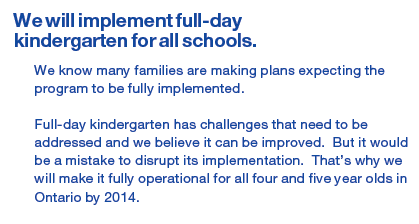
Witmer's local leadership got Hudak to commit to full-day kindergarten in the PC platform, as shown below from page 21 of Changebook:

But when Hudak took his third different position and did a double flip-flop back to opposing full-day kindergarten, and putting at risk the education of thousands of Kitchener-Waterloo children, how did Tracey Weiler stand up for families?
"Weiler said that she “supports the leader’s position” on halting the rollout of full-day kindergarten in the province"
If Elizabeth Witmer didn't believe in Tim Hudak's scheming cuts to education, why should Kitchener-Waterloo families? Tracey Weiler is showing how out of touch she is with Kitchener-Waterloo families by not continuing to support full day kindergarten.
On the important issue of FDK and local leadership, Weiler standing behind Hudak, who "condemned the program" is a sharp and disappointing turn away from previous Progressive Conservative MPP, Elizabeth Witmer, who in her many years of service to the community, was also a strong advocate for full day kindergarten, and showed local leadership by standing up to Hudak over full day kindergarten:
"For two years, Progressive Conservative Leader Tim Hudak had railed against the ambitious new program being rolled out by Ontario’s Liberal government.
So how did Hudak come to see the light?...
Elizabeth Witmer, the party’s tough-minded education critic, told Hudak he was on the wrong side of the issue... Witmer, who wears her social conscience on her sleeve, acknowledged privately to her education contacts that Tory focus groups showed overwhelming support [for FDK]."
Witmer's local leadership got Hudak to commit to full-day kindergarten in the PC platform, as shown below from page 21 of Changebook:

But when Hudak took his third different position and did a double flip-flop back to opposing full-day kindergarten, and putting at risk the education of thousands of Kitchener-Waterloo children, how did Tracey Weiler stand up for families?
"Weiler said that she “supports the leader’s position” on halting the rollout of full-day kindergarten in the province"
If Elizabeth Witmer didn't believe in Tim Hudak's scheming cuts to education, why should Kitchener-Waterloo families? Tracey Weiler is showing how out of touch she is with Kitchener-Waterloo families by not continuing to support full day kindergarten.
Tuesday, August 14, 2012
Tim Hudak flip-flop on full day kindergarten shows Ontario PC's can't be trusted with education file
It's a little late for the Olympics, but Tim Hudak's triple flip-flop on Full Day Kindergarten would win a gold medal in showing how out of touch he is with Ontario families.
Hudak threw his own flip-flopper Tony Genco under the bus today, after Genco said this in regards to full-day kindergarten:
"Mr. Genco not only said he supported the kindergarten program, but added there was no use opposing it because "the ship had sailed" on the issue."
Makes sense for Mr. Genco to say this, after all, this was in the PC platform last year, right on page 21:
So even Tim Hudak thought it would be a mistake to distrupt FDK. Until now:
"Vaughan PC candidate Tony Genco was forced to backtrack on his support of the Ontario Liberals' all-day kindergarten program today after leader Tim Hudak...condemned the program, which is to be fully rolled out by 2014"
This comes after Hudak already flip-flopped on FDK once already. "For two years, Progressive Conservative Leader Tim Hudak had railed against the ambitious new program being rolled out by Ontario’s Liberal government." With education a looming issue for Ontario families, Tim Hudak's flip-flop on a flip-flop shows he can't be trusted with the education file.
Hudak threw his own flip-flopper Tony Genco under the bus today, after Genco said this in regards to full-day kindergarten:
"Mr. Genco not only said he supported the kindergarten program, but added there was no use opposing it because "the ship had sailed" on the issue."
Makes sense for Mr. Genco to say this, after all, this was in the PC platform last year, right on page 21:
So even Tim Hudak thought it would be a mistake to distrupt FDK. Until now:
"Vaughan PC candidate Tony Genco was forced to backtrack on his support of the Ontario Liberals' all-day kindergarten program today after leader Tim Hudak...condemned the program, which is to be fully rolled out by 2014"
This comes after Hudak already flip-flopped on FDK once already. "For two years, Progressive Conservative Leader Tim Hudak had railed against the ambitious new program being rolled out by Ontario’s Liberal government." With education a looming issue for Ontario families, Tim Hudak's flip-flop on a flip-flop shows he can't be trusted with the education file.
Wednesday, October 5, 2011
My story of why I am voting Liberal
This is my personal story of broadly, why I am a Liberal, and more specifically to highlight the change and progress we've made in Ontario under Dalton McGuinty.
I remember during the 90's my parents getting the Harris taxpayer rebate. We were, and are a lower-middle class family, and things weren't always the easiest for us. But I remember very strongly what my parents said about getting the rebate, and what they were going to do with it. "We're going to donate this to the church for charity, because as rough as things can be for us sometimes, some other family out there that is relying on services for help just had that help cut to pay for this."
Fast-forward to 2006. My mother is diagnosed with breast cancer, but thanks to the investments in things like breast cancer screening under the McGuinty government, they catch it early. If we lived in a place without a strong public health system, the financial burden to our family would have been enormous, particularly with myself starting university the same year. But thanks to the McGuinty Liberal government supporting a strong public health system and investing in education, I was able to go to post-secondary while my mom got better. Now, conservatives would call this "socialism", they would call it "social engineering". Me? I think it is a mother being able to watch her son succeed in life. That's Liberal family values to me. That's moving forward. Together.
Please go out and vote today, to keep Ontario on the right track.
I remember during the 90's my parents getting the Harris taxpayer rebate. We were, and are a lower-middle class family, and things weren't always the easiest for us. But I remember very strongly what my parents said about getting the rebate, and what they were going to do with it. "We're going to donate this to the church for charity, because as rough as things can be for us sometimes, some other family out there that is relying on services for help just had that help cut to pay for this."
Fast-forward to 2006. My mother is diagnosed with breast cancer, but thanks to the investments in things like breast cancer screening under the McGuinty government, they catch it early. If we lived in a place without a strong public health system, the financial burden to our family would have been enormous, particularly with myself starting university the same year. But thanks to the McGuinty Liberal government supporting a strong public health system and investing in education, I was able to go to post-secondary while my mom got better. Now, conservatives would call this "socialism", they would call it "social engineering". Me? I think it is a mother being able to watch her son succeed in life. That's Liberal family values to me. That's moving forward. Together.
Please go out and vote today, to keep Ontario on the right track.
Thursday, September 15, 2011
Dalton McGuinty leadership on education praised in The Economist
http://www.economist.com/node/21529014
Great article in The Economist about education reform and progress around the world, and Ontario is right at the top:
“Ontario really is impressive,” enthuses Sir Michael Barber, former head of global education practice at McKinsey (now at Pearson). The Canadian province has a high proportion of immigrants, many without English as a first language, yet it now has one of the world’s best-performing schools systems, after bringing in what one of its architects calls “reform without rancour”.
When Dalton McGuinty was elected Ontario’s premier in 2003, he embraced “whole-system reform”. Instead of directing reforms from the centre, the government encouraged schools to set their own targets and sent experienced teams to help them get there. Schools with large numbers of immigrant children could apply for special help, and could choose whether to extend the school day to do this, or work longer with the slower pupils.
With continued investment in education for families, from full day kindergarten to tuition cuts, Ontario's education system is on the right track.
Wednesday, August 24, 2011
Liberals built this!
www.liberalsbuiltthis.ca
Had a great time this weekend taking part in the province wide Ontario Young Liberal blitz showing the great investments that the Ontario Liberal Party has made in families and communities across the province. Be it new schools, investing in our local health care systems, enhancing our libraries and communities centres, or improving transportation systems to get families and our economy moving, Liberals are on the right track in ensuring a strong Ontario.
Had a great time this weekend taking part in the province wide Ontario Young Liberal blitz showing the great investments that the Ontario Liberal Party has made in families and communities across the province. Be it new schools, investing in our local health care systems, enhancing our libraries and communities centres, or improving transportation systems to get families and our economy moving, Liberals are on the right track in ensuring a strong Ontario.
Thursday, July 7, 2011
Wednesday, June 1, 2011
Tim Hudak vs. Full Day Kindergarten
Today, Ontario is announcing the last stage of the rollout of full day kindergarten. In a highly competitive, globalized, knowledge-based economy it is absolutely essential that Ontario invest in the younger generation to ensure that we build a powerful workforce that can compete and win against the best anywhere on this planet, and investments in families like FDK go a long way to securing Ontario jobs and strengthening our economy.
And up until last weekend, reckless rookie Tim Hudak wanted to scrap this program. But, in his slick, angry, and dark scheming unveiled over the weekend, Tim Hudak - just as he has on human rights, the HST, and creating Ontario jobs – has flip flopped.
What once was a “frill”, he now says he’ll keep. After saying he would “freeze” the program and create two-tier schools, he now says it would be “a mistake to disrupt its implementation”.
Despite his flip-flop, with a $10 billion dollar hole in the middle of his platform, important investments in Ontario families and the future of our economy like FDK would be at risk from Hudak’s reckless rookie schemes. The last PC government promised “funding for education will be guaranteed”, and Ontario families saw schools being closed, students locked out, and less investment in children.
Ontario must continue to keep moving forward with a solid plan for investment, not reckless rookie scheming and flip-flops.
And up until last weekend, reckless rookie Tim Hudak wanted to scrap this program. But, in his slick, angry, and dark scheming unveiled over the weekend, Tim Hudak - just as he has on human rights, the HST, and creating Ontario jobs – has flip flopped.
What once was a “frill”, he now says he’ll keep. After saying he would “freeze” the program and create two-tier schools, he now says it would be “a mistake to disrupt its implementation”.
Despite his flip-flop, with a $10 billion dollar hole in the middle of his platform, important investments in Ontario families and the future of our economy like FDK would be at risk from Hudak’s reckless rookie schemes. The last PC government promised “funding for education will be guaranteed”, and Ontario families saw schools being closed, students locked out, and less investment in children.
Ontario must continue to keep moving forward with a solid plan for investment, not reckless rookie scheming and flip-flops.
Subscribe to:
Posts (Atom)